Welcome to the Preserving the Historic Road International Conference.
We are the leading global forum addressing the identification, preservation and management of historic roads.
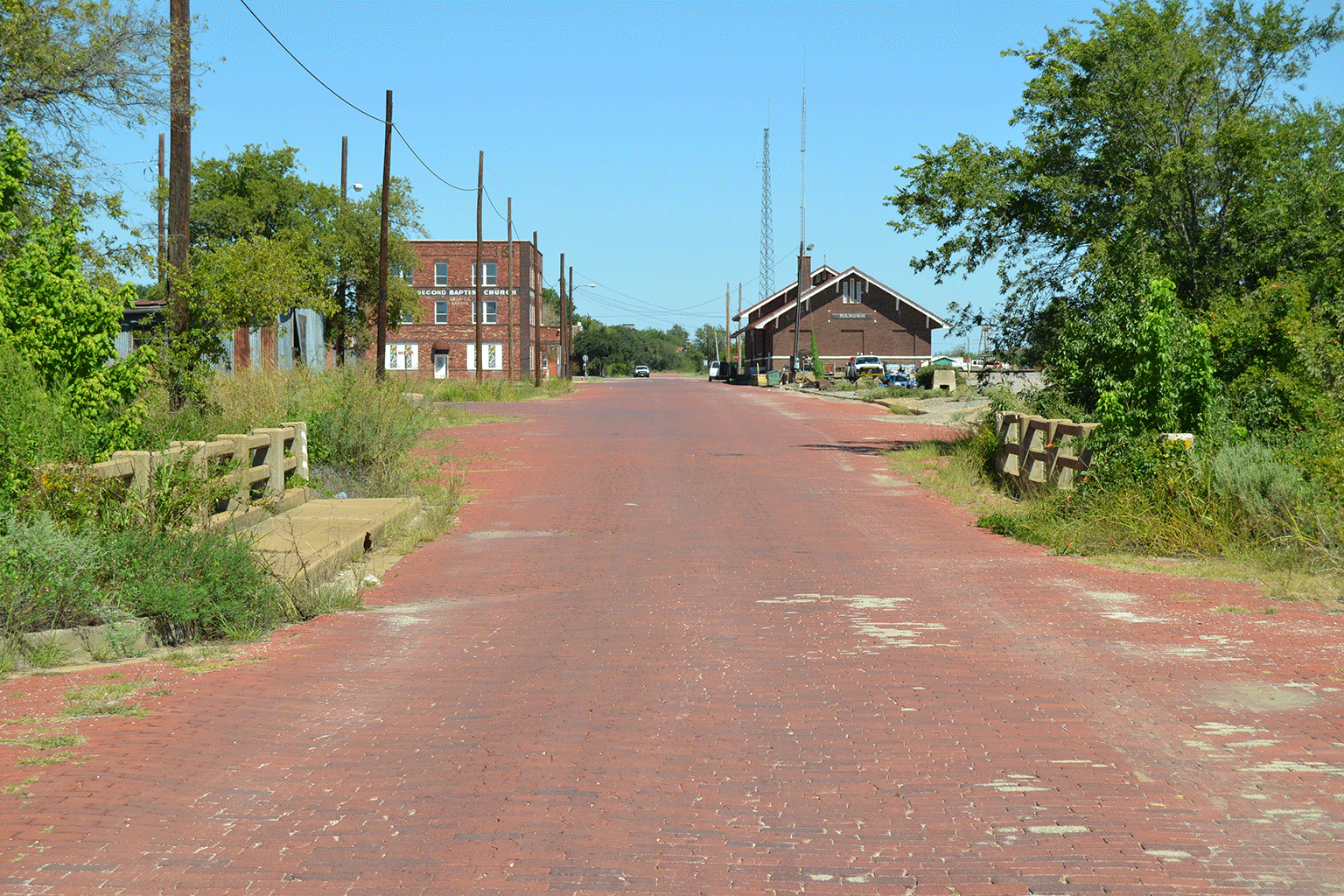
Preserving the Historic Road International Conference
September 30 - October 1, 2026
10:00 a.m. CST - 2:30 p.m. CST
Online conference
Free
Historic Roads is pleased to announce the 13th Preserving the Historic Road Conference to be held virtually. This global gathering will bring together transportation professionals, preservationists, historians, planners, engineers, advocates, and scholars to explore the past, present, and future of historic roads and road related infrastructure.
The 2026 conference is especially timely, coinciding with the 100th anniversary of the U.S. Numbered Highway System and Route 66, offering a unique opportunity to reflect on a century of road building, mobility, culture, and preservation—and to chart a path forward for the next hundred years.
FAQ
What is Preserving the Historic Road Conference?
The national and international conference has been held since 1998 and focused on the history, preservation, and interpretation of highways, roads, and transportation-related cultural resources. The 2026 conference celebrates the 100th anniversary of the U.S. Numbered Highway System and Route 66. Presentations will explore topics ranging from national highway systems and historic roads to preservation techniques and transportation heritage. International topics will also be included.
Is Route 66 a major focus of the conference?
Yes. Several sessions address Route 66 directly, including a panel celebrating its centennial and a presentation examining the post-COVID economic impacts on Route 66 communities.
Will the conference only focus on highways?
No. Sessions address roads, streets, historic signage, parkways, tourism resources, cultural landscapes, civil rights routes, drive-in theaters, and international preservation perspectives.
When is the conference?
The conference will be held online on September 30 and October 1, 2026. Sessions are scheduled from approximately 10:00 a.m. to 2:30 p.m. Central Time each day.
Where is the conference being held?
The conference is being conducted entirely online. Registered attendees will receive information on how to access the virtual sessions.
Is there a fee for registration?
Attendance is free, but advance registration is required.
Do I need to register to attend?
Yes-registration closed on September 18.
Where is the conference being held?
The conference is being conducted entirely online. Registered attendees will receive information on how to access the virtual sessions a week before and the day of the conference.
Do I need any special software to attend?
Participants should have a reliable internet connection. All sessions will be held in Teams which can be accessed via an internet browser if the participant does not have access to a Teams account.
Will presentations be recorded?
No.
Can I attend only selected sessions?
Yes. Registrants may drop in and out using the links provided to join sessions that are most relevant to their interests and schedules.
Will there be presentations relevant to Section 106 and cultural resource management?
Many attendees work in preservation and transportation fields, and discussions of historic roads and transportation resources frequently intersect with Section 106 compliance, National Register evaluation, preservation planning, and stewardship practices.
Who will attend?
Historians
Architectural historians
Cultural landscape architects
Archaeologists
Cultural resource professionals
Transportation planners
Engineers
State DOT staff
Federal agency personnel
Preservation advocates
Students interested in transportation history
Is the conference focused only on Texas?
No. The conference includes perspectives ranging from international and national topics to local preservation case studies.
Does the conference include international speakers?
Yes. A panel on historic roads from a global perspective includes participants from Spain, Australia, Korea, and ICOMOS.
Is this conference appropriate for students or early-career professionals?
Yes. The conference provides opportunities to learn about transportation history, preservation practices, and emerging issues affecting historic roads and related resources.
Will there be opportunities to interact with speakers?
Attendees can submit questions to a session moderator through the virtual conference platform to be discussed during the presentations.
Conference Contacts:
Renee Benn – Renee.benn@txdot.gov | (409) 673-0787
Chris Bell – Christopher.s.bell@odot.oregon.gov | (541) 515-0175
Conference History
Preserving the Historic Road International Conference (PTHRIC) began in 1995 as a regional historic roads conference in White Plains, New York, alongside the historic Bronx River Parkway. This initial gathering, focusing on historic parkways in the Northeast, established the need for a larger and national dialogue—how to accomplish such a mission was still unclear.
In 1997 a Cultural Resources Training Initiative grant from the National Park Service and staff support from the National Trust for Historic Preservation and the California Department of Transportation provided the catalyst needed to consider a national conference. The first planning meeting was held at a restaurant on the historic Plaza in Santa Fe, New Mexico during the 1997 National Preservation Conference. The first national gathering to discuss historic roads was planned for the following spring of 1998—Preserving the Historic Road in America, as the conference was first titled, was born.
The mission established for the first conference was to bring together different viewpoints from different perspectives regarding the identification, preservation and management of historic roads in the United States. Founded during a period when many signature historic roads, such as the Bronx River Parkway (New York), were facing imminent threats for destruction and demolition stemming from safety and liability concerns, the conference organized around the idea of bringing engineers and preservationists—often in adversarial relationships—together for frank conversations and information sharing. Despite the pressures facing many historic roads, this was also a time during which some of the first comprehensive historic road inventories and progressive state transportation policies were being developed—most notably for the Historic Columbia River Highway (Oregon) and the Merritt Parkway (Connecticut).
From the beginning, the conference sought participation in each host state from both the state transportation department and the state historic preservation office. This unusual partnership—strategic, imaginative and symbolic—earned the conference immediate credibility and was soon mirrored by national-level sponsors from the federal government and advocacy organizations. Long term national sponsors include: the National Park Service (NPS), an ongoing sponsor since the first conference in Los Angeles in 1998, the Federal Highway Administration (FHWA), an ongoing sponsor since the second conference in Morristown, New Jersey in 2000, and the American Association of State Highway and Transportation Officials (AASHTO), an ongoing sponsor since the third conference in Omaha in 2002. Regular sponsors and participants have included: the Bureau of Land Management (BLM), US Forest Service (USFS), State Departments of Transportation (DOT), State Historic Preservation Offices (SHPO), Tribal Departments of Transportation (DOT), Tribal Preservation Offices (THPO), Transportation Research Board (TRB), National Transportation Safety Board (NTSB), National Preservation Institute (NPI) and the National Trust for Historic Preservation. In addition, numerous local and regional historic road advocacy organizations and academic institutions have helped to sponsor the conference.
Preserving the Historic Road in America created an environment where issues of highway safety and function could be addressed within the context of a historic road facility. Given the tensions surrounding the topic of historic roads, particularly in the early years, the conference consciously established an environment that would be viewed as objective, neutral and diverse. While the initial purpose behind the conference was halting further losses to the nation’s historic roads, it quickly became a forum for sharing innovations and advancements in technology, research, engineering and historic preservation. After the 2004 conference, the name was changed from Preserving the Historic Road in America to Preserving the Historic Road due to increasing participation by attendees outside the US. As the conference matured, it became an international forum for historic roads. In 2018, the twentieth anniversary of the conference, the name was changed to Preserving the Historic Road International Conference.
Since the founding, Preserving the Historic Road has striven to create an environment that is enjoyable, collegial, intelligent and purposeful. As a result, transportation departments have become better stewards of historic roads, and preservationists have become better advocates for flexible design policies that recognize safety and function. The conference has a proud legacy of education and awareness that has significantly advanced the identification, preservation and management of historic roads in the United States and around the globe.